Sunday, August 29, 2010

Fort Watson Present Day


Below are some picture of Fort Watson that we hope you enjoy. We will be covering this battle in detail at a later date, but we wanted to share the pictures from our on site research.


Present day photo of the Indian Mound/ Fort Watson


Below is a picture from the base of the mound looking up


A picture from the top of the mound


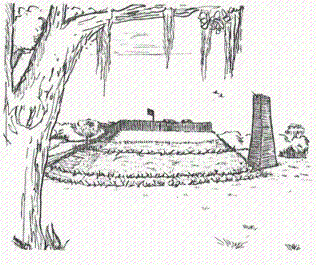
Fort Watson at the time of the battle


Picture of Maham Tower in use


Monday, August 23, 2010

Clinton’s Decision on Long Island; Part 11 Battle of Sullivan's Island

On June 18th, Clinton was sitting on Long Island trying to figure out how to attack the rebels on Long Island with boats instead of dashing across the inlet at low tide on foot. The fact that the inlet was seven feet deep at low tide, instead of eighteen inches deep at low tide was a fact that totally scrapped the plans of Parker and Clinton for a joint attack. Now Clinton was trying to come up a feasible new plan that would not risk his entire force in attacking Sullivan’s Island. He also knew that he and his force would soon be expected to report back to General Howe to help in the planned invasion of New York. The key question is what he could do now to deploy his troops to secure Sullivan’s Island with the smallest risk.


This was still going to be a joint army and navy operation with the main objective being the capture of Sullivan’s Island, but the question now is how to best pull it off with the clock ticking to get the mission accomplished. With the new intelligence in hand, Clinton had several factors to look at to make the new plan of attack. The first of these factors being the intelligence of the area that his forces would be landing on. Clinton knew the northern end of the island had heavy surf which would make landing difficult at best under the best conditions. Landing in open boats full of men and their equipment at the northern end of the island that was guarded by two artillery pieces and dug in infantry would be suicide. His boats full of men would have to pass this rebel position to attack Sullivan’s Island at a different landing area exposed to artillery and rifle fire as they rowed pass to a different landing site further south on the island. The second would be the location of the rebels on the island so as to discern where to best land his troops against the least resistance. By now the information he had was of the position across Breach Inlet, the unfinished fort at the southern end of the island, and a new earth work being built half way across the island manned by in his estimation thousands of troops. The third would be the rebel’s response time to his landing so as to get his troops ashore before the rebels could mass to meet the British as they came ashore. The fourth would be how many men he could land at one time on shore and start their attack on the fort as the Navy bombarded it. The answer to that question is that at the absolute most he could get at one time were seven hundred men on shore and then the boats would have to leave to get a second wave, leaving those troops exposed until the second wave could be rowed back. The fifth question being; how to best use his artillery assets and the Royal Navy to cover his landing in open boats. On land he had six cannon, four mortars and at sea he had three warships with HMS Ranger being on the Atlantic side and HMS Lady Williams and anther sloop being on Hamilton Creek with sixteen cannon among them. The problem with his artillery being that he could gain no advantage against the dug in rebels across the inlet even with placing artillery on Green Island and an oyster bank for better angles to fire at them. Also the Royal Navy could do no better because of the limited movement on the creek.

The more Clinton and his staff went over the options of attack the less Clinton liked his chances at getting across to Sullivan’ Island from Long Island. He and his staff even started looking at trying to land on the main land at Mount Pleasant to try to different rebel attention from the main action by the Royal Navy hoping to cause the rebels to abandon the fort and leave the island without a direct assault. This plan was also difficult because of the marshes and pluff mud that surrounds Mount Pleasant on the coast. Time and again Clinton sent letters to Admiral Parker and aides to try to come up with a plan of coordinated attack. This occurred for several days until Clinton decided on a course of action that finalized the plan of attack on Sullivan’s Island.

He decided that the army would wait and seek whatever opportunities that came available to them during the navel bombardment of the fort. In other words, if he could attack he would, but he would give no formal plans of how or where until he saw how the bombardment was going. He did ask for the Royal Navy to get some ships behind the fort in the cove behind Sullivan’s Island to cover his boats from that side if practical, to cover his amphibious force better. Thus he shifted the success of the operation to the Royal Navy and their ability to rain down lead on the fort and destroy it from the sea which Admiral Parker took on with pleasure.

Thus on June 21st the Royal Crown has a new plan of attack and are waiting to spring it on the rebels who have been bringing in more troops and quickly building up their defenses as the British were debating on how to redesign their attack against Charlestown.

Wednesday, August 11, 2010

Monday, August 9, 2010

General Clinton on Long Island; Battle of Sullivan's Island Part 10

On June the 9th, 1776 General Clinton and his advance force of between 500-700 men land on Long Island. When they set foot on Long Island they were the first British troops to try to bring the British Southern Strategy to life. As they landed they began to secure the island and to prepare for their assault against Sullivan’s Island across Breach Inlet at low tide as they planed aboard their ships.


As the troops fanned out across the island they found no resistance to their landing and securing the island for the Crown. General Lee of the patriot forces in Charleston upon hearing of the British initial landings late in the day sent orders to General Moultrie on Sullivan’s Island to send over troops to harass the landing. Since General Moultrie did not receive the orders till after 8PM he decided that it would be best to wait until the next morning on the 10th before sending troops over to Long Island. During the night of the ninth the troops of the Fifth South Carolina under Col. Isaac Huger and the Sixth South Carolina under Thomas Sumter rifle regiments left their camps at Haddrell’s point on Mount Pleasant and went over to Sullivan’s Island to prepare to go attack the British on Long Island on the morning of the tenth. However General Lee had a change of heart and cancelled the previous orders to send troops over to Long Island and had them return to Haddrell’s point instead on the tenth.

On the tenth of June the British threat to Charleston had became all too real to the local government and military officials. On this date the South Carolina government ordered buildings destroyed at the port to make way for artillery placements and for other obstructions that could slow the British if they were to reach the city of Charleston. The town was in uproar and all those who could leave and had not done so on this date made their exit. Rutledge and the Council of Safety had declared martial law and it was in effect in full force now in Charleston. Also General Lee was at this point making a mad dash tour of the defenses of Charleston to try to make them as ready as possible for the coming British attack. His biggest concern was still the fort on Sullivan’s Island where he was trying to still convince the locals to abandon at this point. Also riders were sent out to hurry along any other regiments that were on the road to Charleston to make all speed to its defense such as the 8th Virginia under the command of Col. Muhlenberg.

Once the British Army and the British Marines finished securing the island they started to prepare for the rest of the army to land on Long Island. The main force landed between June 16th and 18th riding in long boats through the surf with men, cannon, and other military supplies. This build up was watched very carefully by the Patriots at Breach Inlet at the Advance post under the command of Lt. Col. Thompson. As the British began the buildup of troops and stores they began to send observation parties to different parts of the island to observe Patriot movements and defenses. Once such party was assigned getting intelligence back to General Clinton about the Patriot defenses across the Breach where they reported back that they had two cannon and defensive land works up across Breach Inlet. This Patriot force directly across from the British at Breach Inlet guaranteed it would be no walk in park as the British splashed across the inlet at low tide as planned.

The Royal Artillery had landed its cannon and were no doubt preparing to provide cover fire for the troops as they dashed through the inlet and raced across Sullivan’s Island to take the unfinished fort as the Royal Navy pounds the fort with its big guns.

All  was going according to plan for Clinton and Parker as the troops on Long Island prepared for the assault under Clinton and the Fleet under Parker was making ready for a massive bombardment with some of the Royal Navies biggest cannons. Then the unthinkable happened to the entire operation. While doing the last minute reconnaissance of the inlet and the surrounding area it was found that the key information that the entire planned was based on was entirely and whole heartedly wrong. To Clinton’s disbelieve it was accurately discovered that Breach Inlet was not 18 inches deep at low tide, but instead seven to ten feet in certain points at low tide. If as the British planned to dash across the inlet on foot their men would be swallowed up in their heavy uniforms with their equipment. Also to make matters worse it was also discovered that very fast currents with a terrible undertow were present at the inlet making navigating it in a boat very difficult in good conditions, but under enemy fire even that more difficult.

So now the entire operation was up in the air, as Clinton with his top commanders Lord Cornwallis and General Vaughn began to develop a plan B on how to best take the fort on Sullivan’s Island with Admiral Parker. Also keep in mind that the entire expedition against Charleston is on a time table, because General Howe was expecting Clinton and his forces to return to him soon for Howe’s planned conquest of New York.

At this point the geography of Sullivan’s Island and Long Island that Clinton found so horrifying should be explained in some detail so that it is easier to understand the decisions made by the British in Formulating plan B. Long Island has the Atlantic Ocean on its east shore, Hamlin Creek which was navigable by ships to its west coast, Spence’s Inlet to its north coast which ships could pass though to Hamlin Creek, and Breach Inlet to the South divided it from Sullivan’s Island. Between Sullivan’s Island and Long Island is a small piece of land called Green Island just to the west of Long Island before you reach Breach Inlet. It would also play a role in the upcoming battle as an artillery placement area for the British. Sullivan’s Island has the Atlantic Ocean to its east coast, with Hamlin Creek boarding its west shore, Breach Inlet to the north, and Charleston Harbor proper to its south. Also between the southern part of the island and the main land of Mount Pleasant was a cove that could hold ships of various sizes. The main land of Mount Pleasant was separated from the islands of Long, Green, and Sullivans by Hamlin Creek and a vast area of salt marsh and pluff mud which is a substance that smells awful and has the same consistency as quick sand.


With this new correct intelligence in mind; Clinton and Parker have to come up with a new plan of attack on Sullivan’s Island. While they were formulating a new plan the Patriots in Charleston were using this time to try to hurriedly finish their defenses with every precious moment the British were giving them.

Part 10 will be up next Monday

Saturday, August 7, 2010

Monday, August 2, 2010

Thomas Sumter; Part 8 Battle of Sullivan's Island

Thomas Sumter was from the High Hills of the Santee near present day Sumter, South Carolina. He was born in Virginia but immigrated to South Carolina after he made a name for himself fighting in the French and Indian War against the Cherokee as part of the Virginia Militia as a sergeant. He even went to England after the war as an escort for Indian chiefs the British wished to impress. Upon his return he bought land in the High Hills and opened a store, mill, and farm in 1764. As he began to amass wealth over time in the High Hills, he started to resent the taxes he was paying and as a result, he turned to the Patriot cause.

He was elected to the South Carolina Provincial Congress along with a neighbor by the name of Francis Marion in 1774 that first meet on January 11th, 1775. While a member of the Provincial Congress he voted for many acts to distance South Carolina from England, he was considered a radical by many who were at the meetings. Also during this time period Thomas Sumter became a Captain in the local militia of the High Hills area. As a Captain he and his company participated in the Snow Campaign of December 1775 along with others such as Andrew Pickens,  and Lt. Col. William Thomson with the #rd South Crolina Rangers under the command of Col. Richard Richardson with a total force of 4500 men from South and North Carolina which sought out to destroy Tory strong holds and gathering points in the back country of South Carolina. During the Snow Campaign, Sumter was second in command to Col. Richardson and through this opportunity his leadership shown through as the Patriots smashed the Tories in the back country.

As a result of the name he made for himself in the Snow Campaign in February 1776 Thomas Sumter was appointed Lt. Colonel of a new regiment that was being formed in South Carolina. The new regiment would be called the 2nd South Carolina Rifle Regiment and would be made up of recruits from the Northwestern part of the state. They were to be primarily a sharp shooting regiment hence the name rifle regiment; instead of muskets they were issued rifles when possible as their primary weapon. Their name would later be changed to the 6th South Carolina a fact which will help the reader at a later date. They became an active regiment on March 25th, 1776 in Charleston after Sumter began recruiting for the regiment in the back country.

The 2nd South Carolina Rifles at the Battle of Sullivan’s Island under the command of Lt. Col. Sumter was stationed at Haddrell’s Point on Mount Pleasant on June 6th, 1776. They were being used as a ready reserve force with other regiments to meet the British if they should try to land on Mount Pleasant, but could also be ferried over to Sullivan’s Island if needed.

So on June the 6th we Find Thomas Sumter not yet the “Gamecock” he would become, eagerly waiting with his men to see what the British next move was to be.

Tuesday, July 20, 2010

Francis Marion enters the picture: Part 8 Battle of Sullivan's Island

With this blog being named after Marion’s Brigade you would figure it would be about Marion. Well to be honest it is, but we had to set the tone for Marion to enter the picture and there are lots of interesting stories about the revolution in South Carolina that we want to share also. So we will try to blend the two at times and concentrate on one or the other at other times.

Francis Marion by the fall of 1775 was a respected elected official in South Carolina politics which had voted for independence and was an officer in the 2nd South Carolina. He was also an experienced militia soldier who had served as an enlisted member of South Carolina Provincial Calvary with his brother and as a lieutenant in the infantry fighting the Cherokee in the back country of South Carolina and Eastern Tennessee in two different wars serving with such men as William Moultrie, Andrew Pickens, and Peter Horry. This military experience served him well in the inner circles of planter aristocracy in Charleston where they selected him to become a captain in the 2nd South Carolina, serving under his old commander from fighting the Cherokees, William Moultrie.

He first is to see action when he was chosen along with two other highly recognized militia military leaders who had join the line infantry Captain Charles Cotesworth Pinckney and Captain Barnard Elliot to take Fort Johnson from the British on June 21st, 1775 by the South Carolina Council of Safety. However, Marion and his men did not take part on the assault against Fort Johnson, which was not defended, since Lord Campbell had already left it earlier and spiked the cannons to keep them out of Patriot use. Marion and his men were still off loading at the transport when the others decide to attack because of  fear of alerting the fort to their presence. With Marion being selected for this assignment it shows just how highly he was thought of in early South Carolina military circles.

After the taking of Fort Johnson the Patriots started to build up defenses in the harbor proper to eject Lord Campbell and the two British ships which he maintained in the harbor to try to keep some control of the colony and to rally Loyalist support to the crown which never materialized. As a result a military depot to store powered, munitions, cannons, and important papers was established at the old fort at the town of Dorchester thirty miles up the Ashley River from Charleston. This fortification  was built in 1757 to protect a brick powder magazine and surrounded by a tabby wall for extra protection during the French and Indian War. As the supplies built up the fears of Loyalist coming from the back country of South Carolina to take the material there increased. As a result Moultrie sent Marion on November 19th, 1775 to Dorchester with command of his company and Captain Huger’s to secure the tabby fort there and make it ready for any possible attack. This was accomplished by Marion without incident and he remanded at Dorchester for some months protecting the very valuable material stored at this site.

The order reads as follows

Dated: November 19, 1775

"To Captain Francis Marion

     You are to proceed with all expeditions with yours, and Cap. Huger's companies to Dorchester, to reinforce the troops there, and to take specialcare in guarding and defending the cannon, gunpowder, and public records at that place. you are to take command of the whole of the troops at that place, till further orders. You are to apply to the commottee in Dorchester, for a sufficient number of negroes in the public service, to remove the cannon lying by the water-side to a spot more safe, and convenient, near the fort or bacrraks, etc.

Willaim Moultrie"


In late January or early February Marion and his detachment was ordered to Fort Johnson on James Island and then to Haddrell’s Point where a battery was nearing completion by the Continental forces while Moultrie and most of the 2nd South Carolina was starting in earnest to build the main fortifications on Sullivans Island. While at the fortifications at Haddrell’s Point, Marion was promoted to Major in the 2nd South Carolina and took his place as second in command to Moultrie. Once this occurred he along with his detachment transferred to Sullivans Island to help with the work on the fortifications there.

So in early June 1776, we find Francis Marion, a Major in the 2nd South Carolina and second in command of the major fortification on the South Eastern side of the island ready to meet their fate against the British Empire.

Wednesday, July 14, 2010

South Carolina’s Navy at the Battle of Sullivan's Island part 7

South Carolina Navy Jack


                                                                                           Defence in action by Conner
On September the fifth, 1775 the South Carolina Provincial Congress ordered three ships for the defense of Charleston Harbor. The ships would provide the back bone for the newly formed South Carolina Navy. This was a time period where each state still provided for its own defense with assistance from other states. As a result each state provided its own army and navy, thus the South Carolina Navy was born in Charleston to defend the harbor. The South Carolina Navy went into action with three ships at first the Defence, Hibernia, and Hawke with a forth Prosper coming on line in December of 1775. These ships provide escort, helped with troop movements, patrolled the South Carolina coast looking for prize opportunities, and helping to secure the harbor. On November the 12th, 1775 the Defence got into the first navel fight of the short history of the South Carolina Navy when it was trying to sink old hulks as obstacles near Hog Island channel to block British ships from attempting to enter the harbor through this channel. The SC Navy Defence traded shots with the HMS Cherokee and HMS Tamar for three hours as she helped place the hulks for sinking in the channel. Fort Johnson with the First South Carolina tried to join the battle but the distance was to far for its cannons and it stopped firing after the shots if fired were not able to reach its targets. These are the same ships that Royal Gov. Campbell was on trying to keep royal control over South Carolina through. The exchange causes no real harm to either of the forces with Defence taking three minor hits, but it did show South Carolina was not ready to back down.

Defence vs Tamar and Cherokee by Conner
On January 10th, 1776 the Defence was the ship selected to carry the troops selected to form the battery on Sullivans Island to the island. After she got the men and material off board safely she then stayed near the island to provide protection to the work force as they began to build the first primitive battery on the island.

Also in the spring of 1776, the Defence and a newly commissioned ship in the South Carolina Navy the Comet began patrolling the coast of South Carolina collecting some prizes for the new navy. This was accomplished while they were also watching out for the British Fleet that was rumored to be heading from Boston to the South. In late May, both of the ships returned to Charleston at different times bring with them captured prizes. Defence was able to bring her prize into the port safely while Comet ended up with her prize grounded as two British ships gave her chase. 

This action in late May ended the open ocean role of the South Carolina Navy as the British Fleet blockaded the harbor on June 2nd. Upon their arrival closing up the harbor until the battle was decided. The new role of the fleet was to help with troop movements around the harbor, to become floating batteries, and to refit while they were in port if supplies were available. Two of the ships that would play a role in the defense of Sullivans Island would be the Defence and Prosper.

The unified defence plan of Charleston which included the harbor and the town called for the navy to place the Defence and the Prosper in key positions in the harbor to offer support to the main two forts. The Prosper would be placed close to James Island near Fort Johnson and the Defence would be placed near Hog Island channel to offer support to the battery on Haddrell's Point and the fort on Sullivans Island.

Thus, once the Royal Navy shows up outside the harbor, the unified defence plan is put into action and the South Carolina Navy gets ready for action.


Monday, July 12, 2010

The British finalize their plans; Battle of Sullivans Island part 6

At the start of June, General Clinton and Admiral Parker had made their way to Charleston harbor with their combined task force of navy and army personnel. This was an impressive force with over 50 ships of all sizes descriptions preparing for their attack on Charleston. The fleet included 52 ships including HMS Bristol (Flagship, 50 guns), HMS Experiment (50 guns), HMS Actaeon, HMS Active, HMS Solebay, HMS Syren, HMS Sphinx, HMS Friendship, HMS Lady Williams, bomb vessel HMS Thunder, transports, supply ships and others with totaling around 300 heavy navel guns. The ground component of the task force was divided up into 2 brigades. The First Brigade was commanded by Lt. Col James Webster with the Light Infantry Companies of the 4th, 15th, 28th, 33rd, 44th, 46th, 54th, 57th, and the 28th and 37th full regiments of the line.

The Second Brigade was commanded by Col. Charles Earl Cornwallis with the 15th, 33rd, 46th, 54,  57th Regiments of the Line, the 1st Royal Marine Regiment, and the 84th also referred to as the “Young Highlanders” or “Royal Highlander Emigrant Regiment”, a provincial regiment that was supposed to come to full strength in North Carolina until the Battle of Moore’s Creek Bridge ended that hope with the defeat of the Scottish provincial recruits there. The British Army had committed over 2,800 men to this expedition, first against New Bern in North Carolina and now against Charleston in South Carolina, once the North Carolina expedition was cancelled. The artillery component of the army was manned by the Number 1, 2, and 4 companies of the Royal Artillery manning ten guns.


With this combined task force, Admiral Parker and General Clinton along with thier staffs went over possible plans of attack to take Sullivans Island and to seal Charleston Harbor off to the outside World with a mighty blow from the King’s Army and Navy. As early as middle May Admiral Parker had been getting reports from the ships he had sent to Charleston Harbor to gather intelligence about the harbor and its defenses that the harbor was being fortified. In these reports he received information about Fort Johnson and other works being built up by the rebels. The one that got the most attention was the fortification being built on Sullivans Island, where it was being reported that a substantial fortification was being built there to control the northern entrance to the harbor. Clinton and Parker agreed that if Sullivans Island could be taken that they could shut down Charleston Harbor to all trade and could tie down a large rebel force that would have to either try to remove the British from Sullivans Island if they took it or would have to act as a holding force to prevent the British from attacking other points on the coast from a base on Sullivans Island. The key to this is, understanding that taking Charleston was never an option for the British. They did not have the man power to take Charleston proper nor the ability to raise Loyalist to come to their aid in the initial fight in trying to take the town proper. One of the key advisers for this plan of shutting down the harbor was Royal Gov. Lord Campbell who was able to with two Royal ships the HMS Tamer and HMS Cherokee to prevent shipping in the harbor until he left in the fall of 1775. If the British were able to accomplish this it would have been a major blow to the commerce of the Patriots but also the production and distribution of war material.

The initial plan was being ironed out once the British Fleet moved into Five Fathom Hole in Charleston Harbor a safe part of the harbor out of range of Patriot artillery and summer storms on the open sea. Admiral Parker wanted to do a combined attack with the Royal Navy and Royal Army affecting a “coup de main” against the unfinished fortifications on the island. To accomplish this he was going to use the heavy artillery of the fleet to reduce the fort while General Clinton used the flat boats of the fleet to land on the Northern side of the island during the navel bombardment. After the army landed in the small boats under Parker's plan they were to fight their way across the island to the back of the fort and gain entrance from the unfinished part of the fort. Thus taking control of the fort and sealing off the harbor for the British. General Clinton had another idea of how to take the fortification on Sullivans Island. His plan was to land his men on Long Island and have them charge over from Long Island to Sullivans Island across Breach Inlet which according to his intelligence or lack thereof was only 18 inches deep at low tide. Thus he would be able to deploy his field artillery to cover his advance against the rebels across the inlet as his troops splashed across the water and towards the unfinished fort. This would reduce the risk of boats over turning in the surf full of troops during an attack and would allow his men to first disembark from the fleet with little trouble and allow organization on the beach before the attack. Once across the inlet as with Parkers' plan they would head to the back of the unfinished fort and take it from the rear. The plus and the minus of the each plan were discussed by the staffs of each officer and by the two primary officers at some length once the fleet was anchored in the harbor. The final decision was made to go with Clinton’s plan of landing at Long Island and attacking from a base camp there.

On June the 9th the plan was put into action as General Clinton with elements of his army began to land on Long Island securing it against no resistance and establishing a temporary camp there to prepare for the assault against Sullivans Island.

  The next article will be on the thunder before the storm

Tuesday, July 6, 2010

The final touches to the Charleston Defense; Part 5 Battle of Sullivan's Island

At the end of May 1776 the British fleet began to move down the coast of North Carolina into South Carolina towards Charleston. As they did this they did not try to hide their movements as they proceeded southward staying alongside the coast most of the way. As a result the Patriots were able to send riders to the capital with the size of the British Fleet and updates of its location along the coast. Examples of this coastal watch program are noted by Gov. Rutledge in written exchanges between himself and patriot officers in the harbor such as Col. Moultrie and Brigadier General John Armstrong who had been named the head of the defenses of Charleston. General Armstrong was an experienced soldier from Pennsylvania who had won praise in the French and Indian War as a commander of Pennsylvania troops and was also an engineer who had began to organize and build the defenses in Charleston. The information gathered and shared by these men told of the British fleet being around forty ships and their location as they came past each parish and safe harbor such as Bulls Bay near Georgetown, North of Charleston.

As the news spread of the impending British Fleet movement’s people began to flee Charleston and head inland to other homes and anywhere where they could safely move their families to. Charleston began at the first of June to resemble a military post rather than one of the busiest commercial harbors in North America with most of the foreign and commercial vessels leaving port and going to safe harbors in the Caribbean and towards Savannah to await the outcome of the impending battle. Also at the start of June, Gov. Rutledge ordered all of the outlying Parish Militia to turn out and to report to Charleston with all speed. This call to the county side was headed by the local and backwoods Parish militia and they started to report in piecemeal to the capital for its defense. For most of this militia it was their first time to Charleston and they were greeted with open arms for the by the Low Country rice gentry who had previously always had looked down on their unwashed cousins from the woods such as the Scotch-Irish, Dutch, and German settelers. You can only imagine what the scene was on the roads to and from Charleston as the town folks from Charleston were heading inland on their buggies and carts with their valuables as the back woods men with their buckskin shirts and hunting rifles passed each other on the roads.

Also starting at the first of June with the sighting of the fleet moving toward Charleston every slave and able body man went to work around the clock on the defenses in Charleston. This building of additional fortifications or finishing fortifications was on the Islands of James and Sullivans, the town proper, and other key points in the harbor.

By June the 7th most of the British fleet had moved into Charleston Harbor and was heading to an anchorage known as Five Fathom Hole in the outer harbor. From this point they could clearly see the fortifications on James and Sullivans Island and began to finalize their plan of attack on Charleston without fear of Patriot interference.

On June the 8th General Charles Lee arrives in Charleston from Williamsburg, Virginia with troops from Virginia and North Carolina and took command of its defense from General John Armstrong who then became the second in command. This change of command was made with the British sitting in the outer harbor with an attack emanate to the Patriots at any moment that the tides and winds were favorable to the British. Charles Lee was born and raised in England and came to the American causes with vast military experiences with the British Army having served in the French and Indian War as a lieutenant and with the 44th Regiment of Foot as a captain. He also has served as a soldier of fortune for the King of Poland before moving to America in 1773 to settle in Virginia. He was considered a military treasure by most of the Patriots from New England to the South. His vast military knowledge made him on par with Washington in the eyes of his new country. So with his arrival in Charleston it made its defenders feel even more confident than before knowing they had a commander with vast amounts of knowledge and experience to help defend their city. Also behind General Lee were a few more troops making their way through North Carolina from Virginia to further aid the defense.

Once General Lee meet with Gov. Rutledge and the Council he took over the defense of Charleston officially and began to examine the defenses. During this process he had some defenses torn down, some built up, and others moved to better effect a defense in Charleston. His biggest issue was with the fortification on Sullivans Island that Col. Moultrie and the 2nd South Carolina along with slaves and other workers were trying to finish with work around the clock under the direction of French engineer Baron Massenbourg . When Lee went to Sullivans Island he found the fort unfinished and his mind undependable. He went so far as to utter a now famous description of the fort as a “slaughter pen” and wanted to remove the troops and cannon from Sullivans Island to be disbursed in other defense positions in the harbor. This idea was floated to Gov. Rutledge and his council where the answer came back a resounding no to leaving the fortification on Sullivans Island. You must remember the Continental Army was still in its infancy and it needed the states support to exist. The states wrote the checks for the army under the Articles of Confederation, but they did not give up their rights. So the first political question came up to General Lee should he try to order the troops off the island or should he give into local authorities? General Lee chose to give in to Gov. Rutledge, but with strings. He ordered as many troops off the island as he could without alarming the local government and removing as much powder as he could also. Thus if the British were able to overrun the island and fortification Lee would limit his initial loses in men and material. Another concern for Lee was the plan for evacuation of the fortification and other island defenses if the British were able to land successfully on the island. While all of this political move and counter move was happening in the city the British Fleet was making preparations for their attack of Charleston just outside of the harbor, but still visible to the Patriots.

General Lee found out that there were not enough boats that could be left on stand by ready for an evacuation of the Sullivans Island or any plans for doing so. As a result Lee ordered a floating bridge from Mount Pleasant be built using barrels as the floating bases for boards to be put across for the troops to escape or reinforce as needed. This bridge was not stable or safe and troops asked to cross over it refused to on the grounds they were in fear for their lives.

Another defense position that Lee found on Sullivans Island was a small fortification being built by a French engineer who had donated his services to the American cause, Captain Ferdinand de Braham that would play a major role in the battle. This fortification was made out of palmetto logs, sand, and some say tabby structure was located on the North East side of the island and it was guarding Breach Inlet which stands between Sullivans Island and Long Island (later renamed Isle of Palms). The purpose of this fortification originally was to prevent small British ships from entering the harbor through Breach Inlet thus getting behind Sullivans Island and making their way into the harbor proper. The ships that could get through this breach would have to be very shallow drafted ships to make it clear and were not considered much threat from this point, however a defensive position was placed there for safety sake. This position was commanded by Col. William Thomson of the 3rd South Carolina Ranger Regiment. This regiment was formed for the defense of the back country of South Carolina by the men of this region. It was formed as a mounted regiment that would fight on foot so that its members could carry a fight to the natives, Loyalist, or other threats with all the speed they could muster. This regiment was accompanied by a detachment of the 4rth South Carolina lead by a Lt. Mitchell (the artillery regiment) to man the 18lb and 6lb guns, Col. Clark with his 1st North Carolina Regiment, Col. Daniel Horry with South Carolina militia, a company of Catawba Indians and other local tribes which had joined this company lead by Captain Boykin, and a company of riflemen calling themselves the Raccoon Company lead by Captain Allston bringing the total to around 750 men at this point. The men at this position also had a 6lb cannon and an 18lb cannon for the defense of Breach Inlet. Fortifications of some type were built to shield the men and the cannon from the expected British attack by ship. This position was referred to as the “Advance Guard” by the Patriots. Just a quick note this position was built before the British landed on Long Island as a deterrent to ships so please keep this in mind as we look at events as they unfold.

On June the 8th the entire British Fleet had entered the outer parts of Charleston Harbor and was resting in Five Fathom Hole. It was at this point that General Clinton sent a message to the defenders of Charleston to surrender. This was rejected by Gov. Rutledge without any discussion and thus the stage is set for the Battle of Sullivans Island in Charleston Harbor.

On June the 9th the British started to land in large numbers on Long Island and began to set up camp and to put pickets across Breach Inlet form the Patriot Advance Guard position on Sullivans Island. The two enemies were now separated by Breach Inlet which the Americans knew to be at least seven feet deep at low tide and which the British were about to learn the same.

According to Chief Justice of South Carolina at the time of the attack William Henry Drayton through his noted that his son John Drayton published at the time of the British attack o Charleston was defended by “6,500 men coming from 1,400 Continentals from North Carolina; 500 Continentals from Virginia; 1,950 Continentals form South Carolina; 700 Charleston militia; 1,972 Parish militia.” It will become very interesting to see how very few of these troops though never fired a shot in the battle to defend Charleston.

The next article will be the British plan of attack.